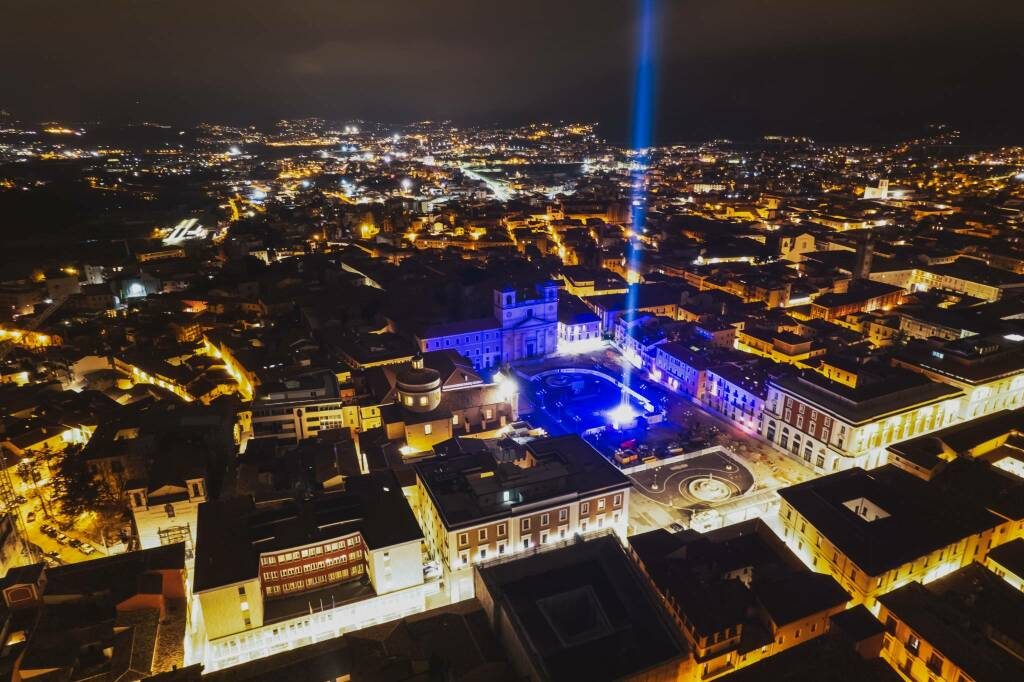
Scrivo questa nota in una mattinata di sole, con il cielo terso e d'un azzurro intenso tutto aquilano. È un giorno particolare, come dal 2009 ogni 6 aprile: il giorno della memoria, del dolore per le 309 vittime del terremoto, ma anche il giorno della riflessione sulla rinascita della nostra indomita città.
All'orizzonte alto l'azzurro combacia con il bianco splendente della cospicua coltre di neve che ricopre sua Maestà, il Gran Sasso d'Italia, fedele custode della nostra terra. Quest'anno, il diciassettesimo dalla sciagura, il giorno cade in pieno periodo pasquale, il Lunedì dell'Angelo, che ricorda l'angelo apparso alle donne nel sepolcro, come racconta il Vangelo di Marco:
"Maria di Magdala, Maria madre di Giacomo e Giuseppe, e Salomè andarono al sepolcro, dove Gesù era stato sepolto, con degli oli aromatici per imbalsamarne il corpo. Vi trovarono il grande masso che chiudeva l'accesso alla tomba spostato; le tre donne erano smarrite e preoccupate e cercavano di capire cosa fosse successo, quando videro un giovane vestito di bianco che disse loro: «Non abbiate paura! Voi cercate Gesù Nazareno, il crocifisso. È risorto, non è qui. Ecco il luogo dove l'avevano deposto.» E aggiunse: «Ora andate ad annunciare questa notizia agli Apostoli», ed esse si precipitarono a raccontare l'accaduto agli altri."
"L'Aquila, nei quasi otto secoli della sua storia, è sempre risorta dai terremoti che l'hanno più volte duramente colpita. Rinata ogni volta più bella di prima, grazie al coraggio e alla determinazione dei suoi abitanti."
— Goffredo Palmerini
Questa coincidenza è anche una buona notizia per la nostra città. Il 6 aprile 2009, per gli Aquilani, distingue non una data, ma il discrimine del prima e del dopo. Il dopo terremoto è un'Era storica nuova per la città e per i suoi abitanti. Un'Era che chiama tutti gli Aquilani a nuove responsabilità nel progettare e costruire il futuro, anche in memoria di coloro che in quella tragica notte di diciassette anni fa persero la vita.
Abbiamo il dovere dell'impegno, generoso e solidale, per il Bene comune, per assicurare alla nostra città, oltre la rinascita materiale, una forte rinascita immateriale e morale, sui valori civili e sui valori universali che hanno finora connotato, e devono ancora connotare, la nostra storia civica. È questa l'indole degli Aquilani, è questo il segreto della resilienza aquilana.
Noi Aquilani abbiamo il privilegio straordinario di custodire la Bolla della Perdonanza, recante il messaggio universale di perdono che 732 anni fa Celestino V affidò alla città il 29 agosto 1294 nel giorno in cui fu incoronato pontefice. E di rinnovarlo ogni anno all'intera umanità celebrando la Perdonanza. L'Aquila è "Capitale del Perdono, della Riconciliazione e della Pace", come papa Francesco la definì il 28 agosto 2022 quando venne ad aprire la Porta Santa della Basilica di Collemaggio. È il prezioso lascito di Celestino, denso di valori più che mai attuali specie per quanto il mondo sta drammaticamente vivendo. Proprio noi Aquilani abbiamo il dovere di proclamarlo e riaffermarlo con forza, sempre, ancor più nell'anno che vede L'Aquila Capitale italiana della Cultura.
Quanto mai attuale il bisogno di Pace in questo tempo martoriato da terribili guerre, immani distruzioni e innumerevoli vittime innocenti, nei conflitti alle porte dell'Europa — Ucraina, Gaza, Cisgiordania, Libano, Iran e paesi del Golfo —, ma anche negli altri cinquanta conflitti disseminati nel mondo che papa Francesco chiamava "terza Guerra mondiale a pezzi". L'umanità sta vivendo uno dei periodi più bui ed incerti della sua storia, per le brutalità e i massacri nelle aree di guerra, ma anche per lo strame che si sta facendo del diritto internazionale e delle organizzazioni sovranazionali.
Sono messi in discussione, ed elusi nella loro funzione, gli Organismi mondiali di garanzia che per 80 anni hanno presieduto all'ordinato procedere dell'umanità, mentre vanno crescendo autoritarismi, autocrazie e "democrature", con la tendenza alla predilezione del "capo", al posto delle democrazie liberali. Gravi le responsabilità di Putin e Netanyahu, che la Corte Penale internazionale ha accusato di crimini contro l'umanità.
C'è da sperare, proprio coltivando la cristiana "Speranza che non delude", in una cessazione delle ostilità e nel faticoso ritorno della Pace. Una missione affidata a tutti gli uomini di buona volontà.
Goffredo Palmerini è giornalista e scrittore aquilano. Questa riflessione è stata scritta il 4 aprile 2026 e pubblicata nel diciassettesimo anniversario del terremoto, il 6 aprile 2026. L'Aquila è Capitale italiana della Cultura 2026.
I write these notes on a sunny morning, the sky clear and deeply blue in that unmistakable Aquilan way. It is a particular day — as every April 6th has been since 2009: a day of remembrance, of grief for the 309 victims of the earthquake, but also a day for reflecting on the rebirth of our indomitable city.
On the high horizon, that blue meets the brilliant white of the heavy snowpack covering His Majesty the Gran Sasso d'Italia, faithful guardian of our land. This year, the seventeenth since the disaster, the anniversary falls in the heart of the Easter season — on Angel Monday, which recalls the angel who appeared to the women at the tomb, as the Gospel of Mark recounts:
"Mary Magdalene, Mary the mother of James and Joses, and Salome brought spices so that they might go and anoint him. When they arrived at the tomb, they found the stone had been rolled away. They were alarmed, wondering what had happened, when they saw a young man dressed in white who said to them: 'Do not be afraid. You are looking for Jesus the Nazarene, who was crucified. He has risen! He is not here. See the place where they laid him. Now go and tell his disciples.' And they went out and fled from the tomb."
"L'Aquila, in nearly eight centuries of its history, has always risen again from the earthquakes that have repeatedly struck it hard — reborn each time more beautiful than before, thanks to the courage and determination of its people."
— Goffredo Palmerini
This coincidence is also good news for our city. For the people of L'Aquila, April 6, 2009 does not merely mark a date; it marks the dividing line between before and after. The post-earthquake era is a new historical age for the city and its inhabitants — one that calls all the people of L'Aquila to new responsibilities in shaping and building the future, also in memory of those who lost their lives on that tragic night seventeen years ago.
We have a duty of generous, solidary commitment to the common good — to secure for our city, beyond material reconstruction, a profound moral and spiritual rebirth, grounded in the civic and universal values that have shaped, and must continue to shape, our civic history. That is the nature of the people of L'Aquila; that is the secret of Aquilan resilience.
We people of L'Aquila hold the extraordinary privilege of safeguarding the Bolla della Perdonanza — the universal message of forgiveness that Celestino V entrusted to the city on August 29, 1294, the day of his coronation as pope. And of renewing it each year to all of humanity through the celebration of the Perdonanza. L'Aquila is the "Capital of Forgiveness, Reconciliation and Peace," as Pope Francis called it on August 28, 2022, when he came to open the Holy Door of the Basilica of Collemaggio. It is Celestino's precious legacy — rich in values more timely than ever, especially given what the world is dramatically living through. We people of L'Aquila, above all, have a duty to proclaim it and reaffirm it forcefully — always, and even more so in this year when L'Aquila is Italy's Capital of Culture.
How urgent the need for Peace in this age ravaged by terrible wars, immense destruction and countless innocent victims — in the conflicts at Europe's doorstep in Ukraine, Gaza, the West Bank, Lebanon, Iran and the Gulf states — as well as in the fifty other conflicts scattered across the world that Pope Francis called a "third world war in pieces." Humanity is living through one of the darkest, most uncertain periods in its history, scarred by the brutality and massacres in war zones, but also by the trampling of international law and supranational institutions.
The world's guarantee bodies — which for eighty years presided over the orderly progress of humanity — are being questioned and evaded, while authoritarianism, autocracy and "democraturas" are growing, with a tendency to prefer the "strongman" over liberal democracy. Grave responsibilities lie with Putin and Netanyahu, whom the International Criminal Court has charged with crimes against humanity.
There is reason to hope — nourishing the Christian "hope that does not disappoint" — for a cessation of hostilities and the long, hard road back to Peace. A mission entrusted to all people of good will.
Goffredo Palmerini is a journalist and author from L'Aquila. This reflection was written on April 4, 2026 and published on the seventeenth anniversary of the earthquake, April 6, 2026. L'Aquila is Italy's Capital of Culture for 2026.